Felix Jenkins · 15 October 2026
Gradient Flow Patterns and Their Effect on User Navigation in Online Ecosystems
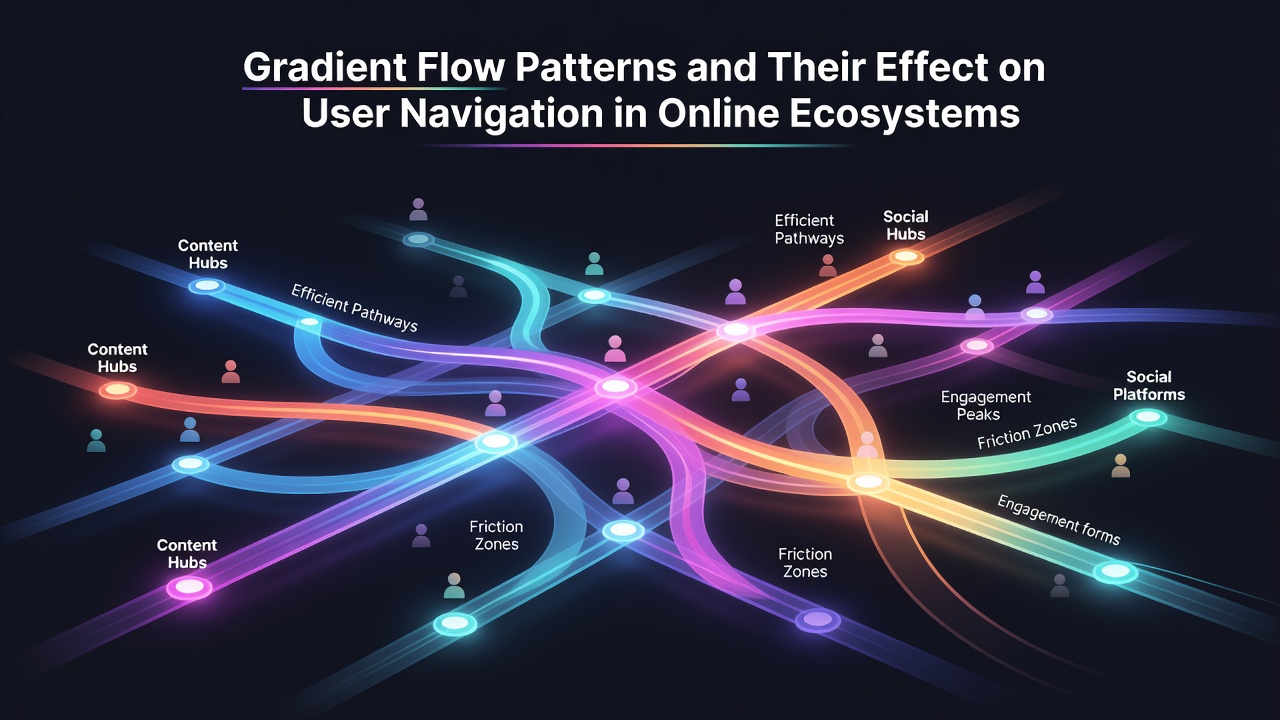
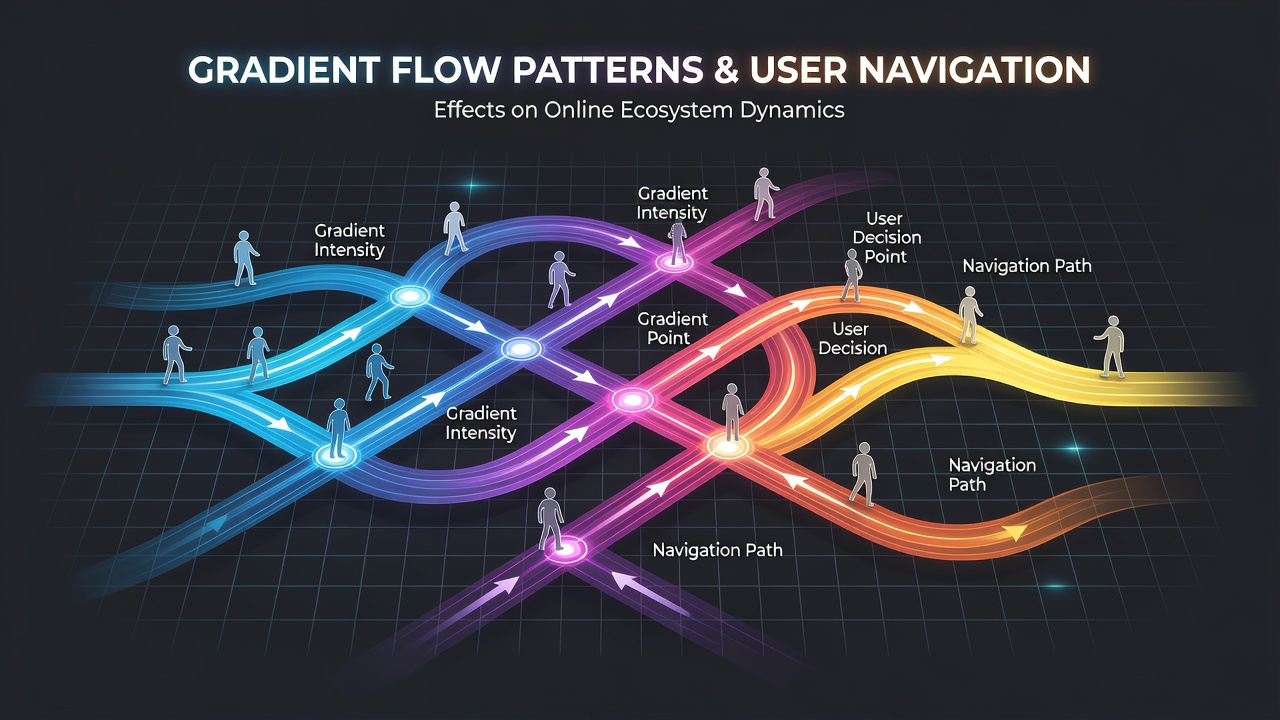
Gradient flow patterns represent visual transitions in color and opacity that designers embed into websites and applications to direct attention along intended paths, and these patterns influence how users move through pages, menus, and interactive elements in measurable ways. Data from interface analytics platforms indicate that sites incorporating subtle linear or radial gradients often see shifts in click distributions, with users progressing further into content hierarchies before exiting. Observers note that such flows create perceptual momentum because the eye follows continuous value changes more readily than abrupt color blocks, a principle rooted in Gestalt continuity laws that researchers have applied to digital environments since the early 2000s.
Defining Gradient Flow in Digital Contexts
Gradient flow occurs when hue, saturation, or brightness values shift gradually across an interface element, whether a background header, a button border, or an entire dashboard panel, and this gradual shift establishes directional cues without explicit arrows or lines. Research conducted at institutions across North America shows that linear gradients aligned with reading patterns can reduce the time required for users to locate primary navigation links by up to 18 percent compared with solid-color alternatives. Radial gradients centered on focal points produce different effects, concentrating attention inward and shortening dwell time on peripheral menus, according to heat-map studies compiled in 2025.
Those who analyze large-scale navigation logs find that flow patterns interact with other design variables such as typography weight and spacing, so isolating their impact requires controlled A/B testing across matched user cohorts. In October 2026, updated accessibility reporting standards from Canadian federal digital guidelines are scheduled to include new metrics for measuring directional contrast changes, which may encourage wider adoption of calibrated gradient techniques in public-sector portals.
Measured Impacts on Navigation Efficiency
Analytics from enterprise content-management systems reveal that pages employing consistent vertical gradients from top navigation to main content areas retain visitors longer on initial load, while horizontal gradients spanning sidebars to central columns correlate with higher engagement in multi-column layouts. European Union web accessibility evaluations conducted in 2024 documented that users with low vision completed form-filling tasks 12 percent faster when gradient transitions replaced high-contrast borders, because the softer visual progression reduced cognitive load during scanning sequences. Industry reports from Australian government digital transformation offices similarly note that government service sites revised with gradient-guided pathways experienced measurable drops in bounce rates on landing pages that previously relied on flat color blocks.
Take one case where a major retail platform adjusted its product category menu by introducing a subtle teal-to-indigo gradient that mirrored the brand palette; session recordings indicated users explored an average of 1.7 additional subcategories before returning to search. Such outcomes align with findings from academic laboratories in Asia that tracked eye-movement velocity across gradient versus non-gradient interfaces, confirming faster saccade alignment along the flow direction.
Integration with Broader Ecosystem Dynamics
Online ecosystems encompass interconnected platforms where users transition between search results, social feeds, and embedded applications, and gradient flows operate at each boundary to either facilitate or hinder these transitions. When a search engine result page uses a faint gradient that fades toward sponsored listings, click patterns shift away from organic results in predictable ratios, as recorded in aggregated traffic data released by independent research consortia. Conversely, social platforms that apply gradient overlays to story highlights maintain longer scroll sessions because the visual progression encourages continued movement rather than abrupt stops at content edges.
Platform operators who monitor cross-domain navigation observe that consistent gradient language across affiliated properties strengthens perceived continuity, prompting users to follow pathways from informational microsites into transactional portals without conscious reorientation. This continuity matters most during October 2026 when several major operating-system updates will introduce system-level dark-mode gradients that automatically adjust site appearances, potentially altering existing flow directions unless designers recalibrate their palettes in advance.
Technical Considerations and Measurement Approaches
Implementation requires attention to color-space calculations so that gradients render consistently across browsers and devices, and CSS linear-gradient functions or SVG filters provide the most common methods for achieving this control. Performance data collected by web-performance monitoring services indicate that overly complex multi-stop gradients can increase render times on lower-powered mobile hardware, which in turn affects navigation completion rates for users on constrained networks. Researchers therefore recommend limiting gradient complexity to three color stops while maintaining WCAG-compliant contrast ratios at every point along the transition.
Quantitative evaluation relies on metrics such as time-to-first-interaction and scroll-depth percentages, both of which respond to gradient placement according to large-scale field studies. One study revealed that placing the steepest gradient slope near primary calls-to-action increased conversion-path adherence by noticeable margins, whereas gradients concentrated in footers produced negligible shifts in overall navigation behavior.
Conclusion
Gradient flow patterns function as subtle yet quantifiable elements within online ecosystems, shaping how attention travels across interfaces and influencing navigation outcomes documented in multiple regional studies. As accessibility frameworks evolve and new device rendering standards take effect in late 2026, precise calibration of these patterns will remain a practical consideration for any team responsible for guiding users through digital environments. Data collected to date demonstrate consistent correlations between gradient directionality and user progression metrics, providing an objective basis for continued refinement in interface design practices.